 Fort Wayne Egress Windows
 Window Well Installation & Replacement in Fort Wayne
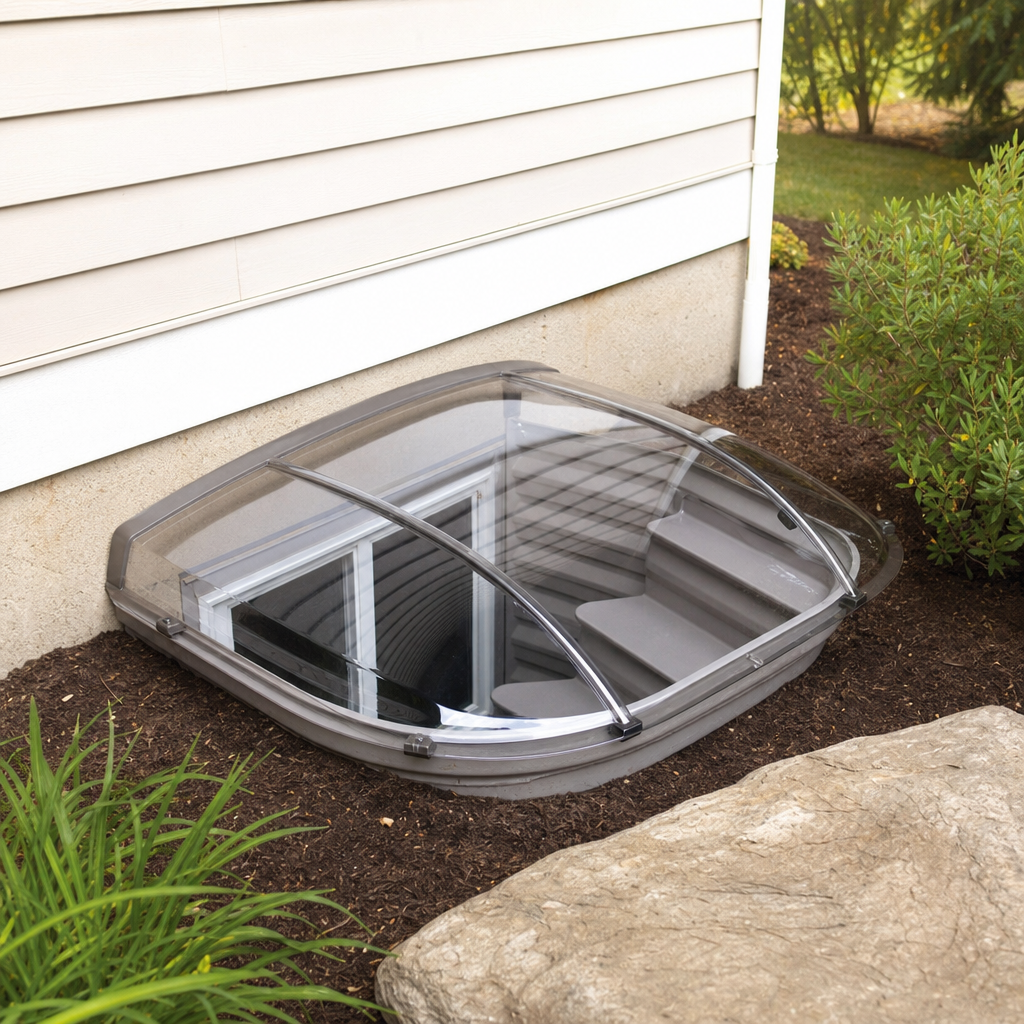
A window well is the open pit that holds soil back from a below-grade basement window, and under egress code, it’s a regulated structure with exact minimum dimensions, a ladder rule, and a drainage job to do. We install code-sized wells as part of full egress projects and replace failing wells in existing openings across Fort Wayne. Replacement wells run $1,000–$3,000 depending on material and depth; wells included in a full egress install are built into that job’s flat price.
If your current well is rusting through, pulling away from the wall, or holding water like a stock tank every March, this page is for you.
The code numbers a well has to hit
For an egress window below grade, IRC R310, adopted by the Indiana Residential Code, requires:
- Horizontal area of at least 9 sq ft
- Minimum 36 inches wide and 36 inches of projection from the foundation wall
- A permanently attached ladder or steps if the well is deeper than 44 inches, with rungs at least 12” wide, projecting at least 3” from the wall, spaced no more than 18” on center
- The well can’t block the window from fully opening, and any cover must open from inside without keys or tools
Those dimensions exist so an adult can climb out, and so a firefighter in gear can climb in. Undersized “flower-pot” wells around an otherwise compliant window are one of the most common inspection failures we’re called to fix, especially on basements finished decades ago. If you’re prepping for a sale, our code compliance upgrades page walks through the whole checklist.
Materials, honestly compared
| Well type | Cost position | Life expectancy | Notes |
|---|---|---|---|
| Galvanized corrugated steel | Low end | 15–25 years | The workhorse. Rusts eventually, faster near downspouts. |
| Polyethylene / composite | Middle | 40+ years | No rust, smooth walls, built-in ladder steps on many models. |
| Stone-look composite / modular block | High end | Decades | For finished landscapes where the well is visible from a patio or the yard. |
We quote options side by side. Steel is the most affordable well that still passes code, and there’s no shame in choosing it with eyes open. For most Fort Wayne homes, though, the honest answer is composite: the price gap over steel has narrowed, and not doing this job twice is worth it.
Drainage: the part that actually matters
Fort Wayne sits on glacial clay at the junction of the St. Joseph, St. Marys, and Maumee rivers. Clay doesn’t percolate, water that gets into a well either drains through an engineered path or it sits against your window until it finds its way inside. Every well we install gets:
- A gravel drainage bed beneath the well, dug below the ~36-inch frost line so it keeps working in freeze-thaw season.
- A tie-in to the footing drain tile where your house has one, most post-1970s Fort Wayne homes do. Water entering the well rides the tile to the sump.
- A deep gravel dry well where there’s no functioning tile, common in pre-war neighborhoods like North Anthony and South Wayne, where original clay tile has long since silted shut.
- Gravel backfill against the well walls, not the excavated clay spoil, so frost and swelling clay don’t crush or shift the well.
If you only take one thing from this page: ask any bidder where the water in the well goes. A well set on bare clay is a bucket. Drainage repair as a standalone fix runs $300–$1,000, details on the covers and drainage page.
Replacement: what the job looks like
A straight well swap in an existing opening is a one-day job in most cases. We excavate around the old well, unbolt (or break) it free, dig out the silted drainage bed, rebuild the gravel base, set and anchor the new well to the foundation, add the ladder if depth requires it, backfill with gravel, and re-grade so surface water sheds away from the house. If the window itself is an original single-pane or a rotted wood unit, doing a basement window replacement in the same visit saves you a second mobilization. We’ll quote it both ways.
Fort Wayne specifics worth knowing
Frost pressure is real here. Northern Indiana frost depth runs about 36 inches. A well that isn’t anchored and gravel-backfilled gets ratcheted inward a little every winter. That’s the bowed, tilted look you see on older steel wells around town.
The housing stock tells you what you’ll find. Pre-war homes in the central neighborhoods often have shallow, undersized original wells (or none, just exposed block and a tiny window at grade). Post-war ranches from the 40s–60s usually have corrugated steel wells at or past end of life. Newer builds in Aboite and northwest Allen County generally have compliant wells, but builder-grade drainage beds are shallow and silt up. Those are our “well full of water” calls.
Permits. A like-for-like well replacement typically doesn’t need one, but anything involving cutting, enlarging, or a new opening does: through the Allen County Building Department for Fort Wayne, New Haven, and Huntertown addresses, or the local offices for Auburn and Columbia City. We sort that out during the free measure so it never becomes your problem.
Covers: finish the system
A well without a cover collects everything the yard sheds: leaves that silt the gravel, snow that becomes March meltwater, and the occasional trapped rabbit. A fitted polycarbonate cover ($150–$600) closes the system, and on an egress well it must open from inside without tools, which is a code requirement we build to, not an option we mention. Most well installs add one; it’s the cheapest insurance on the job.
Get a flat quote
Send a photo of the well (inside and out if you can) and your neighborhood, and we’ll come do a free on-site measure, depth, drainage, foundation condition, and leave a flat written number. Ranges and what moves them are published on the pricing page. Book before the ground freezes: well work is dig work, and dig season here is April through November.
Frequently Asked Questions
How much does window well replacement cost in Fort Wayne?
$1,000–$3,000 for a well in an existing opening. Galvanized corrugated steel is the low end; composite and stone-look wells run higher. Depth, access, and whether the drainage bed needs rebuilding move the number. New wells as part of a full egress install are included in that job's $3,500–$6,500 price.
What size does an egress window well have to be?
IRC R310 requires at least 9 square feet of horizontal area, with a minimum 36-inch width and 36-inch projection from the wall. If the well is deeper than 44 inches, it needs a permanently attached ladder or steps: rungs at least 12 inches wide, projecting at least 3 inches, spaced no more than 18 inches apart.
Why does my window well fill up with water?
Almost always a drainage failure: the gravel bed has silted up, there's no connection to the footing drain tile, or the surrounding clay is directing roof runoff into the well. Fort Wayne's soil is heavy clay, so water that reaches the well stays unless it's given somewhere to go. We rebuild the gravel bed and tie into drain tile where it exists.
How long do window wells last?
Galvanized corrugated steel typically goes 15–25 years before rust-through, faster where downspouts dump nearby. Composite and polyethylene wells last decades longer and don't rust. If your steel well is flaking orange at the soil line or bowing away from the foundation, it's time.
Do you anchor the well to the foundation?
Always. A well that's only backfilled against the wall gets pushed inward by frost and clay pressure, northern Indiana frost reaches about 36 inches down and our clay swells when wet. We bolt every well to the foundation and backfill with gravel, not spoil.
More egress services
Areas we serve
- Fort Wayne, IN
- Egress Window Installation in Angola and the Steuben County Lakes
- Egress Window Installation in Auburn, Indiana
- Egress Window Installation in Columbia City, Indiana
- Egress Window Installation in Decatur, IN
- Egress Window Installation in Huntertown, Indiana
- Egress Window Installation in Kendallville, IN
- Egress Window Installation in Leo-Cedarville, IN
- Egress Window Installation in New Haven, Indiana
- Egress Window Installation in Roanoke, IN